

The Short Answer
Shiplap is a wall treatment known for clean horizontal lines and a relaxed architectural look, but traditional installation can involve measuring, cutting, nailing, and finishing. For homeowners who want the style without the saw, peel-and-stick wood planks can create a similar finished effect with a simpler install path.
Shiplap is everywhere—on every home renovation show, in every “modern farmhouse” Pinterest board, in the accent wall behind every new restaurant’s bar. And yet most people who want it have the same question: is this something I can actually do myself?
The honest answer: traditional shiplap is a real carpentry project. But in 2026, it’s no longer the only way to get the look.
This guide covers what shiplap actually is, why it became the defining wall treatment of the last decade, and—if you like the aesthetic but not the circular saw—what a better path might look like.
What Is Shiplap?
Shiplap is a type of wooden board that’s been used in construction for centuries, originally as an exterior cladding method for barns and farmhouses. The defining characteristic: each board has a notch (called a rabbet) cut into the top and bottom edges, which allows boards to overlap slightly when stacked horizontally. The overlap creates a tight, weatherproof seal—and a consistent, subtle shadow gap between each board.
That shadow gap—a thin horizontal line running the length of the wall between each plank—is the visual signature of shiplap. It gives the wall depth and rhythm that a flat painted surface can’t replicate.
The traditional shiplap install:
- Boards are stacked horizontally, edge to edge, across the full wall
- Each board is face-nailed or blind-nailed to wall studs
- The rabbet joint creates the shadow line; no spacers needed
- Final step: paint, stain, or seal
In modern interior design, shiplap has been adapted far beyond its barn origins. It’s used vertically as well as horizontally, in natural wood tones or painted crisp white, in full-room applications and single accent walls.
Why Did Shiplap Become So Popular?
The modern shiplap craze has one origin story: Chip and Joanna Gaines. HGTV’s Fixer Upper premiered in 2013, and by 2015 “shiplap” had gone from a construction term to a design movement. The show’s signature aesthetic—white shiplap walls, warm wood tones, industrial fixtures—resonated with homeowners who wanted spaces that felt both casual and elevated.
But the trend stuck because it works beyond just farmhouse contexts:
- Farmhouse / Rustic: Natural weathered wood or painted white, horizontal runs
- Coastal / Nautical: White or gray shiplap with maritime accents
- Modern / Scandinavian: Vertical shiplap in natural oak, clean lines
- Industrial: Dark-stained shiplap with metal hardware
- Traditional: Painted shiplap as a backdrop for classic furniture
The shadow gap does real work in every setting—it breaks up a flat wall, adds visual texture, and catches light differently throughout the day.
Traditional Shiplap: What the Install Actually Involves
This is where the “Saturday project” fantasy meets the reality of a real carpentry job.
Tools required:
- Circular saw or miter saw (for end cuts and around obstacles)
- Nail gun (or hammer + finish nails—slower and harder)
- Level (critical—a slightly off-level first board compounds across every subsequent board)
- Stud finder
- Tape measure and pencil
- Safety glasses and hearing protection
Process:
- Find and mark all wall studs
- Start from the bottom (or top) with the first board perfectly level
- Cut boards to length for windows, doors, outlets, and corners
- Face-nail or blind-nail each board through the rabbet into studs
- Fill nail holes (if face-nailed)
- Sand
- Prime and paint, or apply stain/sealer
Realistic timeline: A 10×10 ft accent wall with no obstructions takes most competent DIYers 6–8 hours. A full room is a weekend. Add 30–50% time if you’re new to using a saw.
Common mistakes:
- First board not perfectly level → every subsequent board compounds the error
- Not accounting for outlets (need to cut out precisely)
- Forgetting to seal or prime before painting (shiplap soaks paint)
- Using boards that aren’t fully acclimated to indoor humidity → gaps appear later
Shiplap Pros and Cons
The case for traditional shiplap:
- 100% real wood—authentic grain, texture, weight
- Permanent, structural feel
- Can be refinished, repainted, or restained years later
- Works on walls, ceilings, and exterior applications
- Wide range of wood species available (pine, oak, cedar, spruce)
The honest cons:
- Requires tools, skills, and time
- Mistakes are hard to fix (nail holes, misaligned boards)
- Not reversible without damage to drywall
- Raw wood requires finishing: sand + prime + paint or stain
- Labor costs add up fast if you hire out: $5–$15/sq ft installed
What Does Shiplap Look Like? (And What It Doesn’t)
Shiplap is frequently confused with a few similar-looking wall treatments:
Shiplap vs. beadboard: Beadboard has narrow vertical panels with small raised ridges (“beads”). Shiplap runs horizontally with a clean shadow gap. Beadboard reads as cottage/traditional; shiplap reads as farmhouse/modern-rustic. Full comparison: Beadboard vs. Shiplap →
Shiplap vs. tongue-and-groove: Both are interlocking board systems, but tongue-and-groove doesn’t produce a shadow gap—the joints are flush. Tongue-and-groove looks smoother and more formal; shiplap reads more rustic.
Shiplap vs. board and batten: Board and batten uses wide vertical planks with narrow strips (“battens”) over the seams. It’s a bolder, more architectural look. Shiplap is subtler—the shadow line is the texture, not large vertical divisions.
Shiplap vs. wainscoting: Wainscoting covers only the lower portion of a wall. Shiplap typically runs full height or is used for a full accent wall. Wainscoting vs. Beadboard: full guide →
Want Shiplap Without the Saw?
Here’s where it gets interesting.
“I was looking at traditional barnwood and shiplap for a guitar wall in my office, but wasn’t a fan of the effort it took to install those, not to mention the potential damage to the wallboard. A friend of mine turned me on to Stikwood and it had the best outcome I could have imagined.”
—Michael, verified Stikwood customer ★★★★★
Stikwood makes peel-and-stick real wood planks that deliver the shiplap aesthetic—horizontal wood grain, natural variation, that warm textured look—without any of the traditional installation complexity.
The planks are real wood (reclaimed barnwood, solid oak, and more), pre-finished in 30+ finishes, and backed with a factory-applied adhesive. You peel, stick, and you’re done.
What you skip:
- No nail gun, no circular saw, no stud finder
- No nail holes to fill, no sanding, no priming
- No contractor, no weekend commitment
- No permanent wall damage—removes cleanly
What you get:
- 100% real wood grain—not a print or laminate
- Pre-finished and ready to hang
- 30+ finish options including weathered barnwood, white wash, natural oak
- An afternoon install instead of a weekend project
“I do NOT have a DIY bone in my body, so I fully intended on hiring someone. As I read through the reviews and watched the videos, I gathered the strength to try it myself—and did it! If I can do it, anyone can! The quality of the wood is fantastic. Couldn’t be happier and worth every penny!”
—Kayann, Verified Buyer ⭐⭐⭐⭐⭐
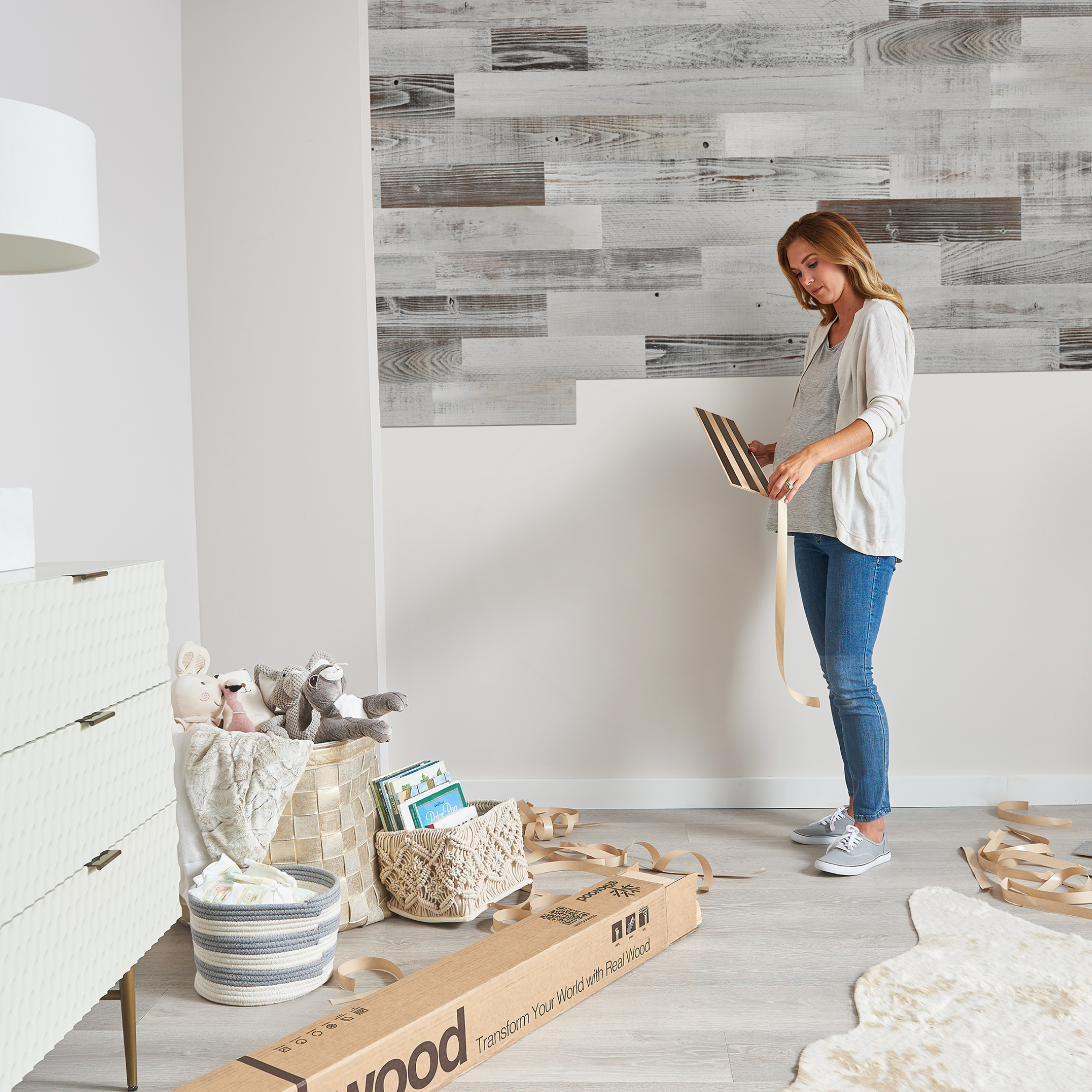
Get the Shiplap Look—Without the Saw and Nails
Stikwood combines the warmth and variation of real wood with an easy peel-and-stick backing, so you can transform a room without hiring a contractor.
The 3-Way Shiplap Comparison
| Feature | Traditional Shiplap | DIY Shiplap Kits | ⭐ Stikwood Peel & Stick |
|---|---|---|---|
| Material | Real wood | Real wood or MDF | 100% real wood |
| Tools needed | Saw, nail gun, level | Saw, nail gun | None |
| Install time | 6–8 hrs (accent wall) | 4–6 hrs | 2–4 hrs |
| Reversible? | No | No | Yes—removes cleanly |
| Pre-finished? | No | Sometimes | Yes—30+ options |
| Skill level | Intermediate | Beginner–Intermediate | No experience needed |
| Made in USA? | Varies | Varies | Yes—Grand Rapids, MI |
Shiplap Design Ideas: How to Use It in Your Home
Accent wall: The most popular application. A single shiplap wall behind a bed, sofa, or dining table creates immediate focal-point impact without committing to a full-room install.
Bedroom headboard wall: Horizontal shiplap in a warm wood tone (or painted white with subtle texture) creates a built-in-feeling headboard alternative.
Fireplace surround: Shiplap around a fireplace mantel is a classic combination—the horizontal lines frame the vertical fireplace opening cleanly.
Home office or reading nook: A shiplap accent wall adds texture and definition to a functional space, making it feel more considered and designed.
Entryway or mudroom: High-traffic walls benefit from the durability of wood paneling. Shiplap at full height makes a strong first impression.
Ceiling: Shiplap on a ceiling reads as cottage-meets-beach-house. Works especially well in bedrooms and covered outdoor spaces.
Ready to Try the Look?
If you want shiplap in your space without the weekend project, Stikwood is the starting point:
- Browse shiplap-style plank finishes →—Reclaimed barnwood, weathered gray, natural oak, white wash, and 25+ more.
- Watch the install →—15 minutes to read, 2–4 hours to complete. No tools.
Related reads:
→ Beadboard vs. Shiplap: Key Differences (And a Better Third Option)
→ Wainscoting vs. Beadboard: Key Differences (And a Better Third Option)
→ How to Finish Shiplap Edges

